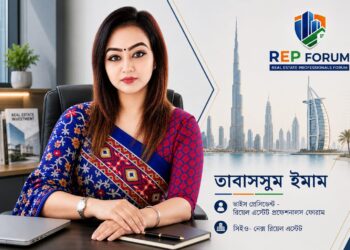




Tabassum Imam
Vice President,
Real Estate Professionals Forum
—
Housing is one of the most fundamental human needs. Yet Bangladesh’s real estate sector is currently experiencing one of the most challenging periods in its recent history. For an extended period, the market for plots, apartments, and residential properties has remained sluggish, while new investment continues to decline.
Many real estate companies are being forced to sell plots and apartments with little or no profit simply to cover operational expenses. Some firms are struggling to pay employee salaries on time, while others are postponing new development projects due to financial constraints. Multiple economic and regulatory challenges have collectively created a difficult environment for the industry.
Over the past decade, the real estate sector has rarely faced a crisis of this magnitude. The decline in demand, particularly among middle-income buyers in Dhaka, has significantly impacted developers. Industry insiders report that sales for many companies have dropped by 40 to 50 percent compared to previous years. Rising construction costs, high bank lending rates, and economic uncertainty have further deepened the crisis.
Industry stakeholders also point to challenges in opening Letters of Credit (LCs) and the continued strength of the US dollar, which have made the import of construction materials increasingly expensive. As a result, not only real estate developers but also suppliers of construction materials are facing substantial pressure. Industry leaders believe that low-interest financing, tax incentives, and easier access to credit could provide much-needed support and help revive the sector.
The impact of the slowdown is already being felt across related industries. According to industry representatives, demand for construction steel has fallen sharply due to reduced real estate activity. Production levels in some factories have reportedly declined to nearly one-third of their previous capacity, highlighting the broader economic implications of the sector’s stagnation.
Over the last few years, the prices of key construction materials—including steel rods, cement, electrical cables, glass, elevators, and finishing materials—have increased by 30 to 70 percent. Consequently, the cost of implementing new projects has risen significantly, placing additional financial strain on developers.
The real estate sector remains one of Bangladesh’s most important economic drivers. More than 40 industries are directly or indirectly linked to housing and construction, including engineering, architecture, ceramics, paints, furniture, electrical products, steel manufacturing, banking, and construction labor. It is estimated that between 2.5 and 3 million people depend on this sector for their livelihoods. Therefore, a prolonged slowdown in real estate inevitably affects the broader economy.
For middle-income families, homeownership has become increasingly difficult. A few years ago, buyers could access long-term housing loans at relatively affordable interest rates. Today, however, higher borrowing costs have discouraged many potential homeowners from making new investments. At the same time, rising land prices, lengthy approval procedures, utility connection costs, and various administrative expenses continue to increase project development costs. Small and medium-sized developers are particularly vulnerable to these challenges.
Despite the current difficulties, the long-term prospects of Bangladesh’s real estate sector remain highly promising. Rapid urbanization, continued infrastructure development, metro rail expansion, expressways, and planned developments in areas such as Purbachal, Uttara, Savar, and surrounding regions are expected to create new opportunities for growth. Demand for modern housing, secure living environments, and community-based residential developments is also steadily increasing.
As the nation prepares for the upcoming national budget, the government has an opportunity to introduce measures that can help revitalize the housing sector. Policy initiatives such as low-interest home loans for middle-income families, tax incentives for first-time homebuyers, rationalization of duties and VAT on construction materials, and reductions in property registration costs could stimulate market demand and encourage investment.
Furthermore, developers who maintain transparency, compliance, and professional standards should receive easier access to financing and stronger policy support. Such measures would not only strengthen the real estate sector but also contribute to economic growth, employment generation, and urban development.
Real estate is more than just a business. It is an industry deeply connected to people’s dreams, security, and future aspirations. Through coordinated efforts by the government, financial institutions, and professional developers, Bangladesh can build a more sustainable, modern, and internationally competitive housing sector for generations to come.